
How-to guide
How to Saber Champagne: A Step-by-Step Sabrage Guide
Chill the bottle, find the seam, slide and follow through: the safe way to open Champagne with a saber.
By Carlos E Antillano · Last updated: November 8, 2026 · LaguioleEnAubracShop.com, the authorized USA Laguiole en Aubrac distributor
The short answer
To saber champagne, chill the bottle very cold, take off the foil and cage, hold the bottle at 30 to 45 degrees pointing away from everyone, lay the back of the blade flat on the seam and slide it firmly up the neck into the lip in one smooth motion. The cork flies off with a clean ring of glass still around it. It is not about strength or a sharp edge: a cold bottle, the seam and a confident follow-through do the work.
What you need
- A bottle of traditional-method sparkling wine: Champagne, Crémant, Cava or another wine made the same way. These bottles have thick glass and high pressure, and they break the most cleanly.
- A saber, or the back of a heavy chef's knife. A champagne saber is easier because of its length and balance, but the spine of a sturdy kitchen knife works too.
- Somewhere outdoors with at least 20 feet of empty space in front of you.
- A towel to dry the bottle, and safety glasses if you have them.
How to saber champagne, step by step
- Chill the bottle properly. Keep it in the fridge for several hours, or in an ice bucket with water for at least 30 minutes, until it is around 40 to 45°F (5 to 7°C). For the last few minutes, turn it neck down in the ice so the neck is the coldest part. Cold glass breaks cleanly; a warm bottle may not break at all.
- Remove the foil and the wire cage. Keep your thumb on the cork while you do it and until you are ready, because a cold cork can still push out on its own. Dry the bottle with the towel so it doesn't slip.
- Find the seam. Every bottle has two vertical seams where the glass mold joined. Turn the bottle so one seam faces up. This line is your guide to the weakest point: the spot where the seam meets the lip at the top of the neck.
- Hold the bottle firmly by the base, or with your thumb in the punt (the hollow underneath), at 30 to 45 degrees. Point it away from people, pets, windows and cars.
- Lay the blade flat on the seam. Use the back (blunt edge) of the blade, never the sharp side. Rest it on the bottle where the shoulder starts to curve into the neck.
- Practice the motion. Slide the blade slowly up and down the seam a couple of times to feel the path to the lip.
- Slide and follow through. In one smooth, confident motion, slide the blade along the seam into the lip and keep going. Do not chop or hack; let the blade glide. The collar of glass and the cork break off together.
- Let the first splash run, then check and pour. The pressure pushes the wine out and clears any glass. Let a little foam run off, check the rim, and pour. Do not drink from the bottle or touch the broken edge; it is very sharp.
If it doesn't break
- The bottle isn't cold enough. This is the most common cause. Put it back on ice, neck down, for 10 more minutes.
- The blade left the seam. Re-check that you are sliding along the seam, not beside it.
- You stopped at the lip. The motion has to continue through the lip, like a follow-through in golf or tennis.
- The blade wasn't flat. Keep it nearly flat against the glass, angled only slightly.
Keep the bottle pointed away from everyone the whole time you adjust and try again.
Which bottles work best
Champagne and other traditional-method sparkling wines are the easiest, because their glass is thick and their pressure is high. Lighter sparkling wines with less pressure, such as some Prosecco, can be harder to saber and may not break cleanly. Avoid bottles with a plastic stopper or a screw cap, and never saber a bottle that is chipped or scratched near the neck. For your first time, start with a standard 750 ml bottle of Champagne, Crémant or Cava.
Safety first
- Saber outdoors, with nothing breakable and no one in front of you for at least 20 feet. The cork and glass collar fly with real force.
- Never point the bottle at anyone, including yourself, at any point, even when you stop to adjust.
- Keep children and pets well back.
- Don't touch the broken lip and don't drink straight from the bottle.
- Pick up the collar and cork afterwards; the glass edge is sharp.
- Saber before the party gets going, not after a few glasses.
Where sabrage comes from
The tradition is usually credited to the cavalry of Napoleon's era, the hussars, who were said to open bottles of Champagne with their sabers to celebrate victories. Whether or not every story is true, the custom lives on in France and around the world as the most theatrical way to open a bottle at a wedding, a New Year's Eve party or any big celebration.
Choosing a champagne saber
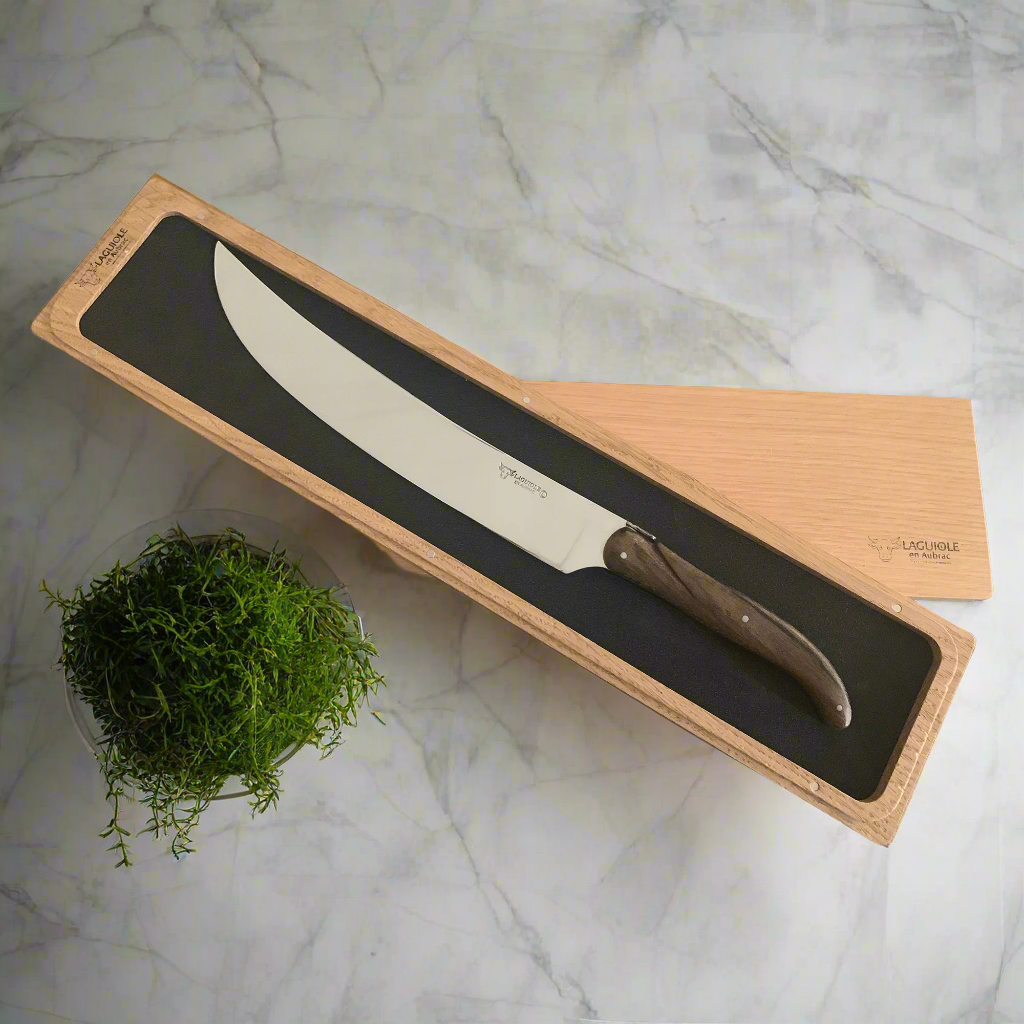
A saber made for sabrage has a long, rigid, deliberately unsharpened blade: you strike with the back, so there is no need for an edge, and a blunt blade is safer to handle and store. All six Laguiole en Aubrac champagne sabers, handmade in Espalion, in the Aubrac region of France, share the same blade:
- 10.6-inch (265 mm) blade in mirror-polished 12C27 stainless steel, left unsharpened
- 16.2 inches (405 mm) overall, 10.5 oz (298 g)
- Six handles: olivewood, juniper and ziricote ($269.95), buffalo horn ($279.95), solid horn and sheep horn ($299.95)
- Covered by our limited lifetime warranty against manufacturing defects
Olivewood is the easiest handle to look after and a good first saber; horn gives the most traditional, formal look. See every handle side by side on our champagne saber comparison, or shop all champagne sabers.
Caring for your saber
Wipe the blade after use, dry it well, and keep it out of the dishwasher, which dries out wood and cracks horn. A light wipe of mineral oil on the handle once or twice a year keeps it from drying out. Store the saber in its box. More tips are on our care and tips page.
Frequently asked questions
How do you saber a bottle of champagne?
Chill the bottle to around 40 to 45°F, remove the foil and cage, and hold the bottle at 30 to 45 degrees pointing away from people. Lay the back of the blade flat on the vertical seam and slide it firmly up the neck into the lip in one smooth motion, following through. The cork and a ring of glass break off cleanly.
Does a champagne saber need to be sharp?
No. You strike the lip of the bottle with the back of the blade, not the edge. Laguiole en Aubrac champagne sabers are deliberately left unsharpened.
Can you saber champagne with a kitchen knife?
Yes. Use the spine (the blunt back) of a heavy chef's knife, never the sharp edge. A saber is easier because it is longer and better balanced for the motion.
How cold should champagne be to saber it?
Around 40 to 45°F (5 to 7°C), with the neck as cold as possible. Turning the bottle neck down in an ice bucket for the last few minutes helps the glass break cleanly.
Can you saber Prosecco?
Sometimes, but it is less reliable. Many Proseccos have lower pressure and lighter glass than Champagne, so the neck may not break cleanly. Champagne, Crémant and Cava are the best choices.
Is sabering champagne dangerous?
It can be if done carelessly. Saber outdoors, never point the bottle at anyone, keep at least 20 feet clear in front of you, and don't touch the broken lip or drink from the bottle. Done this way, it is a safe and memorable tradition.
Does glass get into the wine?
The pressure in the bottle pushes the wine and any glass outward, away from the bottle. Let the first splash run off, check the rim and pour normally.
Where does sabrage come from?
The custom is usually credited to Napoleon-era French cavalry, the hussars, who were said to open Champagne with their sabers to celebrate. Today it is a classic at weddings and New Year's Eve parties.
Customer care
Still have a question?
Write to us and a real person will help you, whether it's about an order, a handle or a gift.