Laguiole en Aubrac
Laguiole en Aubrac The Trapper Hunting Folding Knife, 4.3-in - Olive Wood
Laguiole en Aubrac The Trapper Hunting Folding Knife, 4.3-in - Olive Wood
Holiday Gift Guide: find the right Laguiole gift
SKU:L0514CUIHSOL
Couldn't load pickup availability
- Made in the Aubrac region, France
- Every item is unique, fully handcrafted
- Authorized USA Laguiole en Aubrac distributor
- Every item comes with its certificate
The big Laguiole, built for the field.
The L0514 Hunting Knife takes the timeless lines of the Laguiole – the yatagan blade, the curved "pistol" handle, the forged bee – and scales them up for real outdoor work. A thicker handle fills the hand for a secure grip, and a taller, 4 mm-thick blade handles substantial cuts at camp, on the hunt, or at the table.
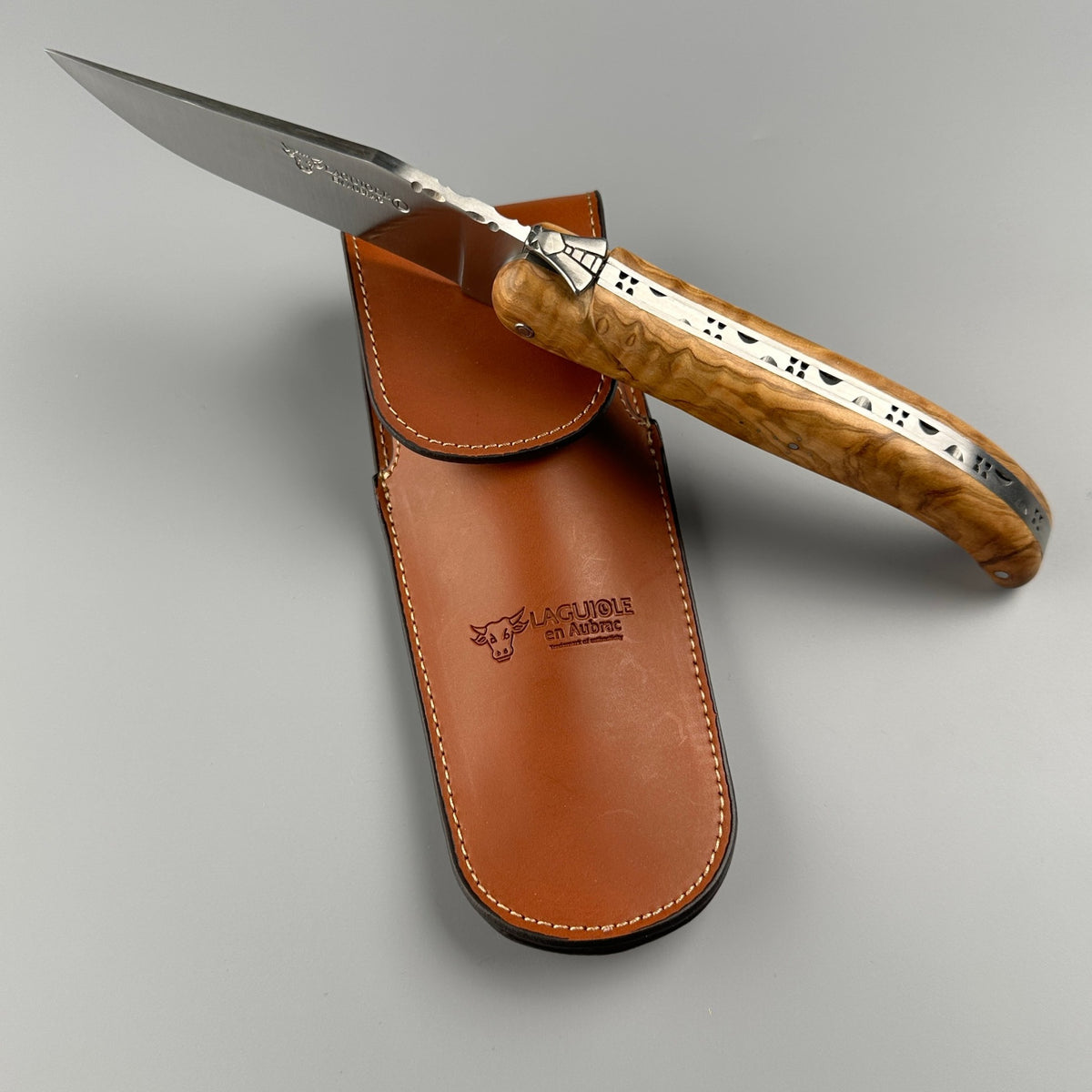
This example is dressed in solid olivewood (olivier) with an exceptional, highly figured grain. Because every handle is cut from a single piece of wood, no two knives look alike: the one in these photos is the one you receive.
The handle
The handle is full solid olivewood from end to end, with no metal bolsters, so the wood’s figure runs uninterrupted from pivot to butt.
- A wood that moves. The grain is anything but straight. It swirls, ripples and folds across both scales in rolling waves and cloud-like eddies, like the surface of a stream or the contour lines of a map.
- Rich, warm palette. Honey gold and caramel blend into deeper amber and toffee, traced with fine chocolate-brown lines that outline each swirl. The colors seem to shift as the knife turns in the light, giving the grain a three-dimensional shimmer.
- Natural burl eyes. Near the pivot, small round eyes and dimples dot the grain, a hallmark of highly figured olivewood.
- Shepherd’s cross (croix du berger). The front scale carries the traditional cross of small inlaid steel pins around a central rivet. Legend says shepherds on long summer pastures planted the knife upright in their bread and prayed before the cross.
- Clean reverse side. The back scale is left plain, with a single central pin, so the full swirl of the grain shows.
- Sculpted shoulder. Near the pivot, the wood is hand-carved into the stepped Laguiole shoulder that echoes the classic bolster line.
- Satin-smooth finish. The scales are polished to a soft, warm sheen. Olivewood is dense, hard and naturally oily, so it resists moisture well and deepens in color with age and handling.
- Openwork spine. From above, steel liners frame a hand-pierced back spring with a repeating pattern of half-moons and four-point crosses.
- Forged bee. The bee is forged in one piece with the spring and given a hand-chased, darkened finish that highlights its sculpted wings.
The blade and mechanism
The blade is Sandvik 14C28N Swedish stainless steel, stamped on the reverse side of this knife. It is a fine-grained, nitrogen-alloyed steel known for taking a keen edge, holding it well, and resisting corrosion – a strong choice for a knife that will see blood, water and weather.
- Yatagan profile. The classic gently curved Laguiole shape, with a long belly for slicing and skinning and a fine point for detail work.
- Built for heavy use. About 3 cm tall and 4 mm thick at the spine, noticeably stouter than a standard Laguiole blade.
- Flat grind. Ground on both faces at roughly 22° to the edge, balancing clean cutting with an edge that does not roll quickly.
- Thumb rests. The bee and the top of the ricasso both serve as natural thumb rests for controlled cuts.
- Back-spring action. A traditional non-locking slip joint: the spring holds the blade firmly open or closed, with the satisfying snap Laguiole knives are known for. The spring is polished on the inside and forged as one piece with the bee.
Craftsmanship and origin
Each L0514 is made entirely by hand at the Laguiole en Aubrac workshops in Espalion, inside the historic Laguiole production zone of the Aveyron. Depending on the version, a single knife takes from 109 to 216 working steps, from forging the blade and spring to carving and polishing the horn.
Laguiole en Aubrac helped revive knifemaking on the Aubrac plateau, where the tradition had nearly died out, and runs its own forge so every metal part is made locally. The brand certifies its knives with the LOG (Laguiole Origine Garantie) mark, guaranteeing they were made in the knife's region of origin.
Care
- Clean and dry after use. Wipe the blade with a damp cloth and dry it fully, especially after cutting game or acidic foods.
- No dishwasher, no soaking. Water and heat can crack or warp natural horn.
- Feed the horn. Rub in a drop of neutral oil or wax now and then to keep it from drying out; avoid prolonged sun or heat.
- Oil the pivot. A tiny drop of oil at the pivot keeps the action smooth.
-
Close it gently. Guide the blade shut with your fingers clear of the edge rather than letting the spring snap it closed.
Specifications:
- Handle: Solid Olive wood; no bolsters; shepherd's cross of inlaid pins (front side)
- Blade: Yatagan shape, flat grind (-22 grades); Sandvik 14C28N, satin finish
- Blade Length: 4.3-in (11 cm)
- Blade Height: 1.2-in (3 cm) / 0.16-in (4mm)
- Closed Length: 5.4-in (13.8 cm)
- Overall Length: 9.75-in (24.7 cm)
- Weight: 6.14 ounces (174 gr) 174 g
- Mechanism: Back spring, non-locking slip joint, two hand opening
- Spring and Bee Forged in one piece, hand-chased; openwork pierced spine
- Origin: Handmade in Espalion, Averyon, France (historic Laguiole zone)
What's included
- Laguiole en Aubrac L0514 Hunting Knife, solid horn tip
- 22-page genuine Laguiole artisanal charter guide
- Leather case
- Certificate of authenticity